Valheim Animal Pens: Keep Access, Supplies and Protection Manageable
A pen is a small base system with its own routine. Confirm the animal’s current taming conditions, prepare the enclosure and decide who maintains it before expecting a dependable supply.
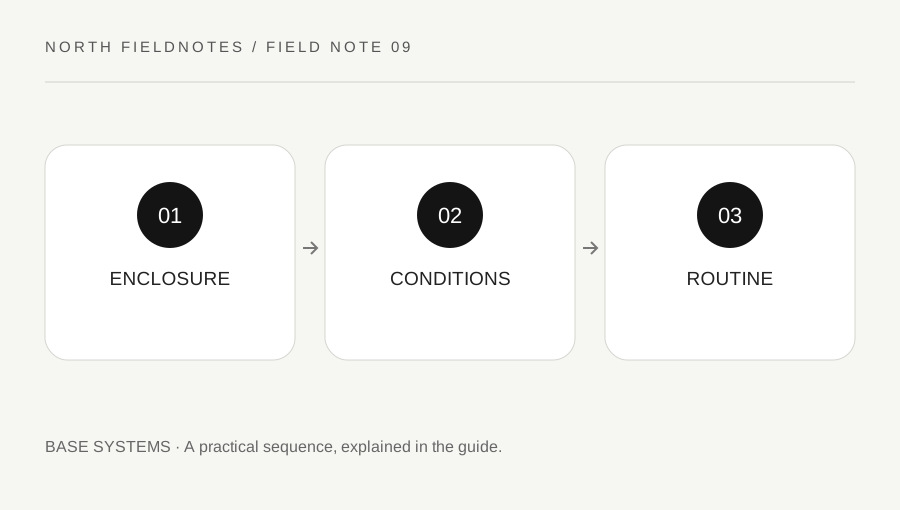
Original explanatory diagram. Examples illustrate a method or decision; they are not claims of personal testing.
Choose one supported animal system
Iron Gate describes taming and keeping animals as part of Valheim's base economy. Begin with one animal the current game supports and read the relevant in-game conditions rather than assuming every creature can be handled alike.
Separate the tasks of bringing an animal into the enclosure, satisfying its conditions and maintaining the resulting group. A completed wall does not prove the process is finished. Keep the visible animal state and messages in view instead of treating a guessed timer as confirmation.
This guide avoids permanent food lists, percentages or breeding intervals. Those details can depend on the animal and current version. The management method remains useful because it connects the enclosure and supplies to observed state rather than promising an instant result from a generic diagram.
Prepare the enclosure and access first
Inspect boundaries, gates and the route used to enter and leave. A gap that is convenient for the player can also make the enclosure fail at its purpose. Check how ordinary movement through the base interacts with the pen so repeated errands do not create accidental openings.
Consider nearby threats and the construction's actual condition. Do not assume that placing animals close to the main house automatically protects them from every event. Keep the pen included in the base's ordinary inspection and repair routine.
For a worked example, a group places the only gate directly on a busy hauling path. They notice it is repeatedly left open and redesign the access routine before expanding the herd. The correction addresses the predictable interaction, not simply adding more animals to replace those lost through the same gap.
Maintain supplies and observe the state
Use the animal's current requirements to plan supplies, then inspect whether the intended condition is actually being met. An item stored in a chest is not automatically available to the animal, and a supply placed nearby may not satisfy every relevant condition.
Keep a small record of what was done and what the game displayed afterward. If progress appears stalled, change one plausible condition and observe again. Do not repeatedly destroy and rebuild the whole enclosure while losing track of the original state.
In co-op, name who checks the pen before a long expedition. Shared ownership without a clear next task can leave every player assuming another person handled the supplies. Keep any resource reserve visible so food production for the players does not silently consume everything allocated to the animal system.
Expand only after a reliable small cycle
Review whether the current enclosure can be entered, maintained and inspected without confusion. If more animals create crowding or handling problems under the game's actual rules, address the condition before adding further capacity. Bigger is not automatically more reliable.
Link output to the base's needs, but do not promise a fixed yield from an unverified setup. Record the real result across your own sessions and keep version or modifier changes visible. A modded animal system should not be presented as default game behavior.
Finish with a simple routine: boundary check, state check, supply check and recorded next task. This makes the pen part of a sustainable base rather than an isolated building project. The useful outcome is a system the group understands and can maintain while continuing exploration, not an enclosure whose operation depends on one player remembering an undocumented sequence.
A practical checklist
Choices are saved in this browser. Reset them here or clear this site’s browser storage.
Questions that come up
Does a finished enclosure mean taming is complete?
No. Check the animal’s visible state and the current conditions. Construction and animal progression are separate tasks.
Can every animal use the same food or timing?
Do not assume so. The current animal-specific requirements govern the process.
Should a modded result be called default behavior?
No. Record the modded configuration and avoid transferring its results to an ordinary world.
References & scope
Background references checked on 18 October 2026. Worked examples and diagrams are original teaching material.