Valheim Route Notes: Mark the Return, Not Just the Discovery
A resource pin is only part of an exploration record. Keep the route, landing, hazards and return conditions visible so another trip does not repeat the same uncertain search.
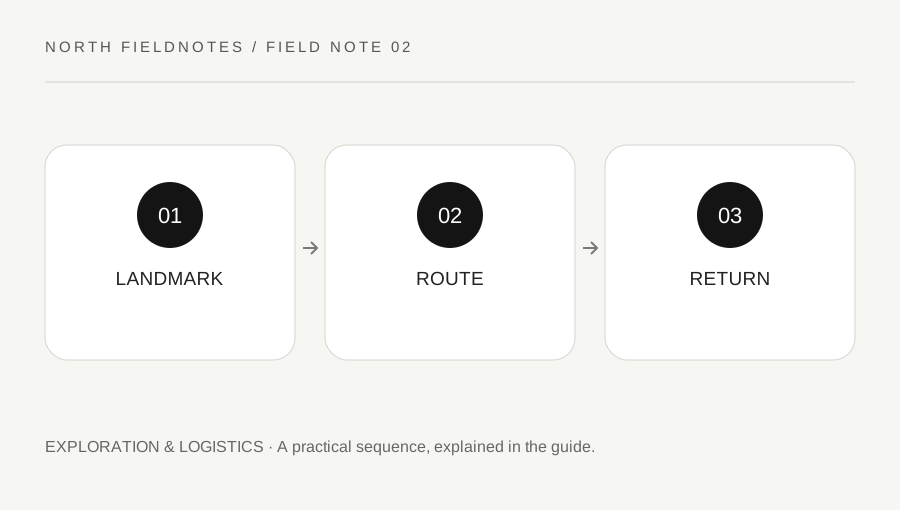
Original explanatory diagram. Examples illustrate a method or decision; they are not claims of personal testing.
Name what the marker actually means
Use a small consistent set of labels for discoveries, outposts, landing points and unresolved hazards. A pin called ore can become unhelpful when several deposits or stages of collection exist. Include whether the site was merely seen, sampled or already worked.
The map and available sharing tools depend on the actual world configuration and progression. If your world restricts mapping, use ordinary landmarks and a group note suited to those rules rather than assuming every interface feature is available. Do not bypass a shared challenge setting without agreement.
Record uncertainty. A coastline glimpsed from a boat is not a surveyed inland route. A marker for a possible destination should remain a candidate until the approach has been checked. This prevents a later player from reading a rough scouting pin as a confirmed safe expedition plan.
Include the approach and the exit
Describe where the party can arrive and how it leaves with the intended load. A short route when empty may become awkward with cargo or during a retreat. Inspect slopes, water crossings and nearby shelter as part of the route, not as details to discover after the task is complete.
For a worked example, a group marks a useful resource across a channel. The note includes the landing, a nearby shelter point and the route between shore and deposit. It does not simply pin the deposit and assume everyone remembers which inlet avoided the difficult terrain.
Keep the information grounded in what was actually explored. If a path behind a ridge remains unknown, label it unknown. A neat line drawn on a map does not establish that the ground supports the planned cart, boat connection or return movement.
Update the record as the site changes
After a trip, mark what was collected, what remains and which infrastructure now exists. An old discovery pin can attract an unnecessary journey if the useful material has been exhausted or moved. Keep a date or session note when conditions are likely to be confused.
In co-op, agree on who updates shared information. Avoid erasing another player's marker merely because you do not recognize it. Ask what it represents and combine the records when practical. A common label system supports the group better than several private conventions that use the same symbol for different meanings.
If a game update adds world content, read Iron Gate's current explanation of explored and unexplored areas before assuming every previously visited location has changed. Preserve the distinction between a patch announcement and a verified change at your particular site.
Use one route as a review exercise
Choose a familiar trip and reconstruct it from the notes alone. Can another player find the intended landing, identify the next landmark and understand the return plan? Missing information reveals what should be added before a harder expedition.
Do not turn the review into a claim that the route is permanently safe. Enemy activity, weather, character preparation and group decisions can change. A good note names known hazards and limitations rather than promising a risk-free journey.
Finish with a compact route card: destination, approach, known obstacles, task and return. This complements broad biome progression by preserving local knowledge your group actually earned. The goal is reducing repeated confusion and unnecessary travel, while keeping unexplored terrain and changed conditions visible instead of hiding them behind a confident marker.
A practical checklist
Choices are saved in this browser. Reset them here or clear this site’s browser storage.
Questions that come up
Does a map pin prove the route is safe?
No. It records information at a location. The approach, current conditions and preparation still matter.
Should an old site be assumed updated after a patch?
Read the developer’s current world-generation guidance and inspect the actual area. Explored terrain and new content can interact differently.
What if the world limits mapping?
Respect the agreed settings and use suitable landmarks or notes. Do not assume the default map tools are part of that world’s rules.
References & scope
Background references checked on 18 October 2026. Worked examples and diagrams are original teaching material.